
Falling Pickaxe player review
There are no verified player testimonials here, so this page examines Falling Pickaxe through its mechanics, pickaxes, Bonus Buy and 160x maximum win.

No user names, direct quotes or independently verified reviews are available for this page. Instead, this is a transparent analysis of Falling Pickaxe by Pixmove: one reel sends a pickaxe downward through blocks, its HP determines how long the round can continue, and the maximum win is 160x the stake. That gives you a practical way to judge the game without presenting invented comments as community opinion.
📑 Table of contents
How the core mechanic plays
Falling Pickaxe replaces a conventional multi-reel layout with a pickaxe that drops through a vertical column of blocks. Each hit reduces both the pickaxe and the block by 1 HP; when a reward-bearing block breaks, its value is added to the round total. The round ends when the pickaxe reaches 0 HP.
The reel can land on a Cross with no pickaxe, or on a Wooden, Stone, Iron or Diamond Pickaxe. If seven spins in a row show a Cross, the eighth spin guarantees one of the four pickaxes. TNT can destroy blocks within its blast radius, an Upgrade Arrow temporarily widens the tool, and a Workbench repairs it while upgrading it to the next tier.
For the basic rules and game characteristics, see the full game description. These mechanics explain the possible outcomes; they are not verified player testimonials.
Pixel visuals and mining atmosphere
The presentation uses voxel-like pixel blocks of dirt, stone and ore, with TNT adding a clear explosive accent. The falling pickaxe, impact effects and destroyed blocks are easy to follow, so the action remains readable even when several blocks break in quick succession.
Hit sounds, breaking effects, TNT explosions and background music reinforce the mining theme. Players looking for a Minecraft-style slot will recognise the block-based visual language, but the resemblance is limited to the look and atmosphere and does not indicate any connection with Minecraft.
What pickaxe durability means

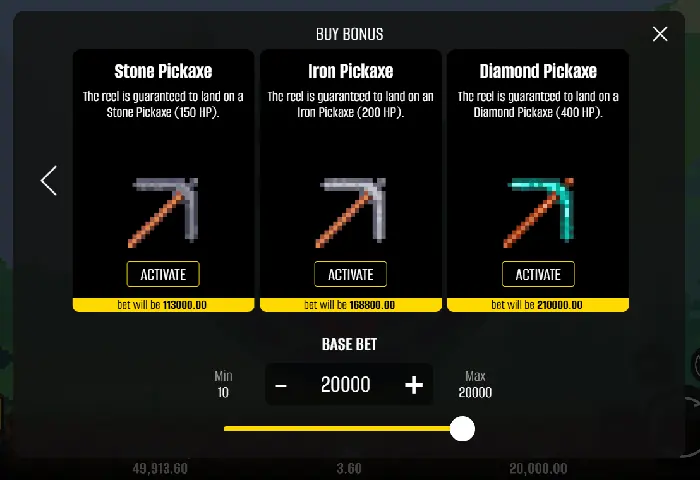
Durability is the main limit on a round. The Wooden Pickaxe has 100 HP, the Stone Pickaxe 150 HP, the Iron Pickaxe 200 HP and the Diamond Pickaxe 400 HP. More HP allows the tool to keep moving for longer, but it cannot guarantee a profit or a particular block sequence.
Block strength matters too. Dirt and Stone have 1 HP, Copper 5, Redstone 10, Gold 15, Diamond 20 and Emerald 30. Their respective rewards are x0, x0.01, x0.05, x0.2, x1 and x5 of the stake. A Workbench fully restores the pickaxe and upgrades it to the next level; on a Diamond Pickaxe it simply repairs the tool.
There is no verified community consensus that the Diamond Pickaxe offers better value. It is more accurate to view it as the option with the largest HP reserve and the highest purchase cost.
How players view Bonus Buy
Bonus Buy provides direct access to a round with a selected pickaxe instead of waiting for one to appear during regular spins. The menu offers Wooden, Stone, Iron and Diamond Pickaxes, with each option priced against the current stake.
It is a quick way to explore the mechanic, but it does not lock in a win amount. The result still depends on the blocks, TNT, Workbench, Upgrade Arrow and the selected tool’s HP. You can try the demo first to learn the interface without staking, although demo play cannot prove that a Bonus Buy will pay back.
Value of Wooden, Stone and Iron Pickaxes
The Wooden Pickaxe has 100 HP and the Stone Pickaxe 150 HP, while the Iron Pickaxe has 200 HP. Their lower durability and generally lower entry cost make them reasonable options for a more restrained stake, but the exact value depends on the displayed Bonus Buy price and your chosen bet.
Gold blocks pay x0.2 of the stake and Diamond blocks x1; TNT can also change how quickly the field is cleared. Even a favourable combination does not make recovery certain. Bonus Buy is charged in advance, while the block layout and event order are not selected by the player.
No genuine user reports are supplied here, so there is no sound basis for calculating an average return for these pickaxes. Compare them by cost, HP and acceptable risk rather than by unverified win stories.
What to expect from the Diamond Pickaxe
The Diamond Pickaxe provides 400 HP and costs more than the other Bonus Buy choices. Its larger reserve can keep the round going longer and may allow the pickaxe to reach blocks such as Emerald, which pays x5 the stake when that reward is collected.
A higher price does not remove the risk. An unfavourable block layout, long stretches of strong blocks or a lack of useful special elements can produce a result below the purchase cost. Diamond is therefore the most expensive route to a longer round with greater potential, not a guarantee of a large win.
Reported wins and big runs
There are no verified player stories, confirmed stake screenshots or named authors on this page. A general description of a big run should not be presented as a documented review. The firm limit available from the game data is a maximum win of 160x the stake.
Several features can contribute to a high result, including the Diamond Pickaxe, valuable blocks, TNT and a favourable chain of destruction. That describes a possible scenario, not a promise. The field and event sequence can be different in every round.
How often do large multipliers appear
Falling Pickaxe is listed with 95% RTP and low volatility. In broad terms, low volatility points to smaller results appearing more regularly than in a game built around rare major hits. It does not mean every session will be profitable or establish a schedule for future wins.
A large multiplier may fail to appear for many spins, even after a run of modest outcomes. RTP is a long-term mathematical measure, not a payout timetable for a short session. A handful of spins cannot establish the true frequency of big wins.
Notable TNT win scenarios
TNT creates the most dramatic possible sequence. When it breaks, the explosion destroys blocks within its radius and may expose more resources or another TNT block. If a chain reaction reaches high-value blocks, the round total can rise well above the original stake.
Specific stories about record wins need a source, date, stake and supporting evidence before they can be treated as genuine player reports. The maximum supported by the available data is 160x. More colourful examples are illustrations of the mechanic, not established facts about someone’s payout.
Demo play compared with real money play
The demo is useful for learning the controls, the round sequence and the pickaxe menu. It lets you see how HP is spent, what happens when TNT is hit and where the available functions appear.
It does not replace checking the real-money terms. Before staking, review the operator’s limits, the Bonus Buy price and the applicable rules. Demo results cannot prove future profitability, so treat the mode as a way to learn the interface rather than evidence that every paid round will behave identically.
Falling Pickaxe strengths and drawbacks
| Strengths | Drawbacks |
| Unusual falling pickaxe and block-breaking mechanic | The 160x maximum win may disappoint players seeking extremely large multipliers |
| Pixel visuals built around blocks, ores and TNT | Bonus Buy can be costly and is not guaranteed to pay back |
| Low volatility with smaller wins expected more often | One pickaxe may run out of durability before it clears tougher layers |
| Pickaxe upgrades and TNT chain reactions add variety to a round | A 95% RTP represents a long-term mathematical house edge |
| Auto Play makes longer sequences easier to run | The straightforward core may not suit fans of complex multi-stage slots |
This is not the result of a verified community poll. The summary is based on the game’s stated characteristics because reliable user-review sources are not available here.
Final assessment and practical guidance
Falling Pickaxe is best assessed as a low-volatility slot with a distinctive block-breaking process, voxel-inspired presentation and a 160x maximum win. There are no verified expert comments or player sources on this page, so the following points are practical guidance rather than attributed reviews.
- Start in the demo to learn HP consumption, TNT and the Upgrade Arrow.
- Compare Wooden, Stone, Iron and Diamond Pickaxes by price, HP and the level of risk you can accept.
- Use Auto Play only after setting firm limits for the stake and number of spins.
- Treat Bonus Buy as a paid entry into a round, never as a way to guarantee a return.
If you want genuine reviews, look for independent posts that include an author, date and supporting material. In its current form, this page offers a candid mechanics review and clearly states that those sources are absent.
FAQ
Which Falling Pickaxe features matter most?
Focus on the selected pickaxe’s HP, the Bonus Buy cost, 95% RTP, low volatility and the 160x win cap. These figures describe the risk more reliably than unverified stories about big wins.
Can the stories on this page be treated as real reviews?
No. There are no verifiable quotes, user names or original screenshots here, so descriptions of large payouts should be read only as possible game scenarios.
What does TNT do in Falling Pickaxe?
When TNT is destroyed, it can blow up nearby blocks within its radius. If other TNT or valuable blocks are close, a chain reaction may follow, but neither the reaction nor its payout is guaranteed.
What is Auto Play used for?
Auto Play runs a chosen number of spins at the stake active when it was enabled. Check your balance and set a session limit before starting; you can stop the sequence manually at any time.